Wednesday, September 16, 2026

NCERT Worksheet Class 8 Maths Chapter 2 Power Play | 20 MCQs with Solutions | CBSE 2026-27

Class 8 Maths Chapter 2 Power Play 20 MCQs Worksheet CBSE 2026-27 New Syllabus Ganit Prakash

Class 8 Maths Chapter 2 Power Play - NCERT 2026-27 Ganit Prakash - 20 MCQs Worksheet

Welcome to Galaxy Coaching Classes! This is the NEW NCERT Ganit Prakash 2026-27 worksheet for Class 8 Maths Chapter 2 Power Play. This chapter covers Exponents, Powers with Negative Exponents, Laws of Exponents, and Scientific Notation. Perfect for CBSE students worldwide.

Board: CBSE | Class: 8 | Chapter: 2 Power Play | Book: Ganit Prakash 2026-27 | Type: MCQ Worksheet with Solutions

๐Ÿ“š Join Our CBSE 2026-27 Telegram Channel

Get daily worksheets, PDFs, and NCERT solutions for Class 6-10 directly on Telegram

๐Ÿ”— Join Now on Telegram
https://t.me/+UfENi_dxgUdjMjk1
Learning Objectives (As per NCERT 2026-27):
✓ Understand exponents and powers
✓ Laws: am × an = am+n, (am)n = amn, a0=1
✓ Negative exponents & Scientific Notation

Worksheet - Chapter 2 Power Play - 20 MCQs with Answers

Q1. 2³ = ?
(a) 6 (b) 8 (c) 9 (d) 16

Q2. 3² × 3³ = ?
(a) 3⁵ = 243 (b) 3⁶ (c) 9⁵ (d) 3

Q3. (2³)² = ?
(a) 2⁵ (b) 2⁶ = 64 (c) 2⁹ (d) 4⁶

Q4. Any non-zero number to power 0 is:
(a) 0 (b) 1 (c) Number itself (d) Undefined

Q5. 10⁻² = ?
(a) 100 (b) 0.01 (c) -20 (d) -100

Q6. 5⁻³ = ?
(a) 125 (b) 1/125 (c) -125 (d) -15

Q7. am ÷ an = ?
(a) am+n (b) am-n (c) amn (d) am/n

Q8. (3/4)⁻² = ?
(a) 9/16 (b) 16/9 (c) -9/16 (d) -16/9

Q9. Standard form of 0.000045 = ?
(a) 4.5×10⁴ (b) 4.5×10⁻⁵ (c) 45×10⁻⁵ (d) 4.5×10⁻⁶

Q10. 1.5 × 10³ = ?
(a) 1500 (b) 15 (c) 0.0015 (d) 150

Q11. (-2)³ = ?
(a) -8 (b) 8 (c) 6 (d) -6

Q12. (-2)⁴ = ?
(a) -16 (b) 16 (c) -8 (d) 8

Q13. 2⁰ + 3⁰ + 4⁰ = ?
(a) 0 (b) 1 (c) 3 (d) 9

Q14. If 2x = 32, x = ?
(a) 4 (b) 5 (c) 6 (d) 3

Q15. (2×3)² = ?
(a) 2²×3² = 36 (b) 2×3² (c) 2²×3 (d) 5²

Q16. (1/2)³ = ?
(a) 3/2 (b) 1/8 (c) 1/6 (d) 8

Q17. 10⁶ ÷ 10⁴ = ?
(a) 10² = 100 (b) 10¹⁰ (c) 10²⁴ (d) 10

Q18. Which is larger: 2³ or 3²?
(a) 2³=8 (b) 3²=9 (c) Equal (d) None

Q19. a⁻โฟ = ?
(a) -an (b) 1/an (c) an (d) 0

Q20. Scientific notation of 1500000 = ?
(a) 1.5×10⁶ (b) 15×10⁵ (c) 0.15×10⁷ (d) 1.5×10⁵


Answer Key - Chapter 2 Power Play

1-b, 2-a, 3-b, 4-b, 5-b, 6-b, 7-b, 8-b, 9-b, 10-a, 11-a, 12-b, 13-c, 14-b, 15-a, 16-b, 17-a, 18-b, 19-b, 20-a

Detailed Solutions with Tricks

Q2. Trick: am × an = am+n. So 3²×3³ = 3⁵ = 243

Q3. Trick: (am)n = amn. (2³)² = 2⁶ = 64

Q5 & Q6. Negative Power: a⁻โฟ = 1/an. So 10⁻² = 1/100 = 0.01 and 5⁻³ = 1/125

Q8. Flip Rule: (a/b)⁻โฟ = (b/a)n. So (3/4)⁻² = (4/3)² = 16/9

Q13. Any number power 0 = 1. So 1+1+1=3

Q19. Most Important Formula: a⁻โฟ = 1/an

๐Ÿ“ฅ Download PDF + Get Daily Worksheets

Join our Telegram group for free PDFs of all chapters

Join Telegram: https://t.me/+UfENi_dxgUdjMjk1

Next Chapter: Chapter 3 A Story of Numbers Worksheet | Previous: Chapter 1 A Square and A Cube Worksheet

Sunday, September 13, 2026

Class 8 Maths Chapter 1 A Square and A Cube Worksheet | 20 MCQs with Solutions | NCERT 2026-27 Ganit Prakash
NCERT Solutions & Worksheet Class 8 Maths Chapter 1 A Square and A Cube | 20 MCQs with Solutions | CBSE 2026-27 New Syllabus


Welcome to Galaxy Coaching Classes! As per the NEW NCERT book Ganit Prakash 2026-27, Class 8 Maths Chapter 1 is now A Square and A Cube (Old Rational Numbers is now Chapter 3). This worksheet has 20 MCQs with detailed solutions as per latest CBSE pattern.

Chapter: 1 A Square and A Cube | Class: 8 | Board: CBSE | Book: Ganit Prakash 2026-27 | Questions: 20 MCQs

๐Ÿ“š Join Our CBSE 2026-27 Telegram Group

Get NEW syllabus worksheets for Class 8 Ganit Prakash daily!

๐Ÿ”— Join Now
https://t.me/+UfENi_dxgUdjMjk1
What you will learn: Squares, square roots, cubes, cube roots, patterns in squares/cubes, estimating roots - as per new NCERT.

Worksheet - 20 MCQs - Chapter 1 A Square and A Cube

1. What is the square of 12?
(a) 144 (b) 121 (c) 169 (d) 124

2. Which is a perfect square?
(a) 50 (b) 64 (c) 70 (d) 80

3. Square root of 169 is:
(a) 12 (b) 13 (c) 14 (d) 15

4. Square of an odd number is always:
(a) Even (b) Odd (c) Prime (d) None

5. How many natural numbers lie between 8² and 9²?
(a) 15 (b) 16 (c) 17 (d) 18

6. What is cube of 4?
(a) 16 (b) 32 (c) 64 (d) 48

7. Which is a perfect cube?
(a) 100 (b) 125 (c) 150 (d) 200

8. Cube root of 216 is:
(a) 6 (b) 7 (c) 8 (d) 9

9. What is 11²?
(a) 100 (b) 121 (c) 144 (d) 110

10. Smallest number by which 32 should be multiplied to make perfect square:
(a) 2 (b) 3 (c) 4 (d) 8

11. Square of 0.5 is:
(a) 0.25 (b) 0.5 (c) 2.5 (d) 0.05

12. Cube of -3 is:
(a) -9 (b) -27 (c) 27 (d) 9

13. Which number's square ends with 6?
(a) 12 (b) 14 (c) 18 (d) 24

14. √0.04 = ?
(a) 0.2 (b) 0.02 (c) 2 (d) 0.4

15. Smallest 3-digit perfect square is:
(a) 100 (b) 121 (c) 144 (d) 169

16. Cube root of 0.008 is:
(a) 0.2 (b) 0.02 (c) 2 (d) 0.8

17. If square ends with 5, cube ends with:
(a) 0 (b) 5 (c) 25 (d) 125

18. Estimate: √300 lies between:
(a) 17-18 (b) 15-16 (c) 10-11 (d) 20-21

19. 1³+2³+3³ = ?
(a) 36 (b) 27 (c) 35 (d) 30

20. Number of zeros at end of 100²?
(a) 2 (b) 3 (c) 4 (d) 1


Answer Key

1-a, 2-b, 3-b, 4-b, 5-b, 6-c, 7-b, 8-a, 9-b, 10-a, 11-a, 12-b, 13-b, 14-a, 15-a, 16-a, 17-b, 18-a, 19-a, 20-c

Detailed Solutions with Tricks (New Syllabus)

5. Trick: Numbers between n² and (n+1)² = 2n. So between 8² and 9² = 2×8=16 numbers.

10. 32=2×2×2×2×2 = 2⁴×2. To make pairs, need one more 2. 32×2=64=8².

18. 17²=289, 18²=324, so √300 is between 17-18. Estimation is new in 2026-27 book.

19. Important Pattern for new book: Sum of cubes = (sum of numbers)². 1+8+27=36 and (1+2+3)²=36.

20. 100 has 2 zeros, square doubles zeros: 100²=10000 has 4 zeros.

๐Ÿ“ฅ Download Full PDF with all Solutions
Download PDF

Join Telegram for Daily New Syllabus Worksheets:
https://t.me/+UfENi_dxgUdjMjk1

Next: Chapter 2 Power Play Worksheet | Also Read: Chapter 3 A Story of Numbers (Rational Numbers) Worksheet

NCERT Worksheet for Class 8 Maths Chapter 3 Rational Numbers - 20 MCQs with Solutions (2026-27)

Welcome to Galaxy Coaching Classes! This free worksheet is for CBSE Class 8 Maths Chapter 3 Rational Numbers as per the latest NCERT syllabus 2026-27. Perfect for practice before exams. All questions are MCQ type with detailed solutions at the end.

Class: 8 | Chapter: 3 Rational Numbers | Type: MCQ Worksheet | Total Questions: 20 | Board: CBSE Worldwide

Instructions:
- Each question has 4 options, only one is correct.
- Try to solve without seeing solutions first.
- Solutions with tricks are given at the end of this post.
๐Ÿ“š Join Our CBSE Maths Telegram Group

Get daily worksheets, PDFs, and NCERT solutions for Class 6-10 directly on Telegram.

๐Ÿ”— Join Now on Telegram
Link: https://t.me/+UfENi_dxgUdjMjk1

Worksheet - Chapter 3 Rational Numbers - 20 MCQs

1. Which of the following is a rational number?
(a) √3   (b) ฯ€   (c) 0/1   (d) None of these

2. The additive identity for rational numbers is:
(a) 1   (b) -1   (c) 0   (d) None

3. The multiplicative identity for rational numbers is:
(a) 0   (b) 1   (c) -1   (d) 2

4. The reciprocal of -3/7 is:
(a) 3/7   (b) 7/3   (c) -7/3   (d) 7/-3 is not allowed

5. Which of the following lies between 0 and -1?
(a) -2/3   (b) 2/3   (c) -3/2   (d) 3/2

6. The rational number that is equal to its own negative is:
(a) 1   (b) -1   (c) 0   (d) 2

7. Value of -2/3 + 4/3 = ?
(a) 2/3   (b) -2/3   (c) 6/3   (d) -6/3

8. Product of a rational number and its reciprocal is:
(a) 0   (b) 1   (c) -1   (d) Number itself

9. Which is greater? -3/4 or -2/3
(a) -3/4   (b) -2/3   (c) Both equal   (d) Cannot compare

10. 0 ÷ (-4/5) = ?
(a) 0   (b) -4/5   (c) -5/4   (d) Undefined

11. If x + 2/3 = 0, then x = ?
(a) 2/3   (b) -2/3   (c) 3/2   (d) -3/2

12. Rational number between 1/2 and 3/4 is:
(a) 5/8   (b) 1/4   (c) 1   (d) 4/5

13. -5/2 + ___ = -5/2. The blank is:
(a) 0   (b) 5/2   (c) -5/2   (d) 1

14. Associative property does NOT hold for which operation on rational numbers?
(a) Addition   (b) Multiplication   (c) Subtraction   (d) Both a and b

15. The standard form of -36/48 is:
(a) -3/4   (b) 3/4   (c) -9/12   (d) -6/8

16. How many rational numbers are there between any two rational numbers?
(a) 1   (b) 2   (c) Finite   (d) Infinite

17. (-3/5) × (5/-3) = ?
(a) 1   (b) -1   (c) 9/25   (d) -9/25

18. If a/b is a rational number, then b cannot be:
(a) 0   (b) 1   (c) -1   (d) 2

19. The additive inverse of 7/-9 is:
(a) 7/9   (b) -7/9   (c) 9/7   (d) -9/7

20. (1/2 + 1/3) + 1/4 = 1/2 + (1/3 + 1/4). This shows:
(a) Commutative property   (b) Associative property   (c) Distributive   (d) Closure


Answer Key

1-c, 2-c, 3-b, 4-c, 5-a, 6-c, 7-a, 8-b, 9-b, 10-a, 11-b, 12-a, 13-a, 14-c, 15-a, 16-d, 17-a, 18-a, 19-a, 20-b

Detailed Solutions

12. Average = (1/2+3/4)/2 = 5/8. 15. -36/48 ÷12 = -3/4. 16. Infinite rationals between any two. 19. 7/-9 = -7/9, inverse = 7/9.

๐Ÿ“ฅ Want PDF of this worksheet + Solutions?
Download Free PDF

For Daily Worksheets Join Telegram:
https://t.me/+UfENi_dxgUdjMjk1
Stay Connected: Join Galaxy Coaching Classes Telegram for Class 6-10 NCERT Solutions, Worksheets & Important Questions Daily!

Sunday, February 11, 2024

How to fill answer sheet of cbse board exam ll class 10 ll class 12 2024


How to fill answer sheet of cbse board exam ll class 10 ll class 12 2024


Hello friends,

In this video i has explained you how to fill the first pafe of your board answer sheet.

Generally i had seen students are very nervous on the 1st day of their board exam paper. so they are making mistakes in it. so i had explaines you that what you have to do in first page in detail with a speciman copy and examples what to fill in it.

if you like it please share withyour friends also so that they can also get this help.


The first Page of board answer sheet is a omr sheet.


Monday, July 24, 2023

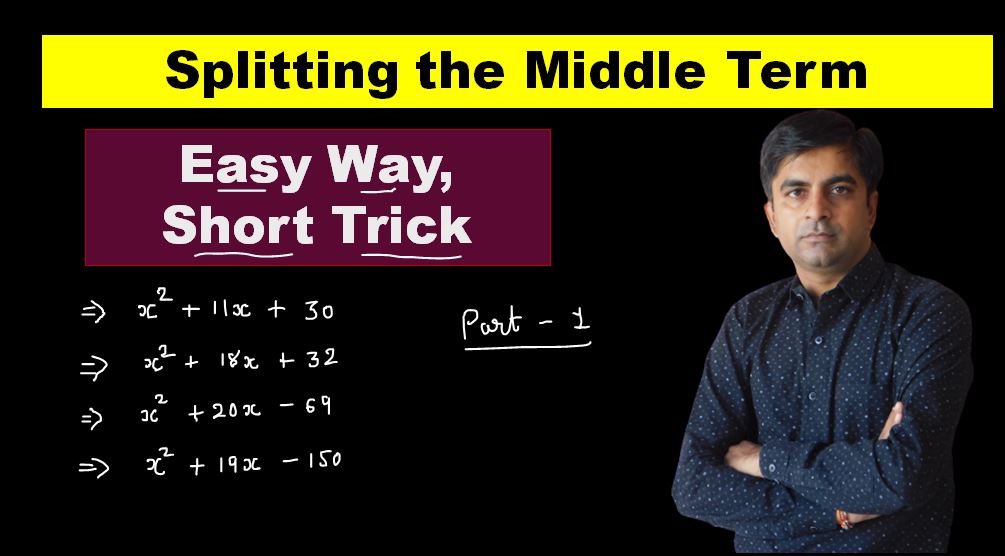
Splitting the Middle Term for Class 8, Class 9, and Class 10


Mastering Algebra: Splitting the Middle Term for Class 8, Class 9, and Class 10

Introduction

Algebra is a fundamental branch of mathematics that lays the groundwork for complex problem-solving and analytical thinking. As students progress from Class 8 to Class 10, they encounter more advanced algebraic concepts. One such essential technique is "Splitting the Middle Term." This method plays a crucial role in factoring quadratic expressions and simplifying equations. In this blog post, we will explore how to apply the technique of splitting the middle term and understand its significance in the context of Class 8, Class 9, and Class 10 mathematics.

  1. What is Splitting the Middle Term?

Splitting the Middle Term, also known as the "ac-method" or "decomposition," is a technique used to factorize quadratic expressions of the form ax^2 + bx + c. The process involves breaking down the middle term (bx) into two separate terms whose sum remains the same, but their product yields the product of the coefficient of x^2 (a) and the constant term (c). This factoring method paves the way for solving quadratic equations efficiently.


  1. Step-by-Step Guide to Splitting the Middle Term

Let's dive into the step-by-step process of splitting the middle term:

Step 1: Identify the quadratic expression in the form of ax^2 + bx + c.

Step 2: Find two numbers, p and q, whose sum equals the coefficient of the middle term (bx) and whose product equals a times c.

Step 3: Rewrite the middle term (bx) as the sum of the two numbers found in Step 2 (p + q).

Step 4: Group the terms in pairs and factor out the common terms.

Step 5: Take out the common factors from both pairs, leaving you with the factored expression.


  1. Applying Splitting the Middle Term in Class 8

In Class 8, students usually encounter simple quadratic expressions. Understanding the concept of splitting the middle term empowers them to factorize these expressions effortlessly. By mastering this technique, they can efficiently solve problems involving algebraic expressions, paving the way for more complex topics in higher classes.

  1. Utilizing Splitting the Middle Term in Class 9

As students progress to Class 9, they encounter more challenging quadratic expressions and equations. Splitting the Middle Term becomes a vital tool in their arsenal for simplifying expressions and solving quadratic equations accurately. Additionally, it provides a strong foundation for grasping higher concepts, such as completing the square and using the quadratic formula.

  1. Mastering Splitting the Middle Term in Class 10

Class 10 marks the culmination of algebraic learning for many students. Splitting the Middle Term becomes even more critical as they tackle advanced topics like factorization of complex expressions and understanding the properties of parabolas. Students who have a firm grasp on this technique will find it easier to handle complex mathematical problems with confidence.

Conclusion

In conclusion, mastering the technique of Splitting the Middle Term is a crucial skill for students in Class 8, Class 9, and Class 10. It serves as a powerful tool for simplifying quadratic expressions and solving equations efficiently. By understanding this method early in their algebraic journey, students build a strong foundation for tackling more complex mathematical concepts in the future. As educators and learners, let's embrace the significance of Splitting the Middle Term and equip ourselves for a brighter mathematical future.

Saturday, July 22, 2023

Real-Life Math: How Mathematics Shapes Our Daily Lives

Introduction

Mathematics is an integral part of our everyday lives, often operating in the background, making our routines smoother and more efficient. From managing personal finances to making smart shopping decisions, math plays a crucial role in various real-life scenarios. In this blog post, we will explore the practical applications of math in finance, shopping, and other everyday situations, highlighting how this essential subject shapes our daily lives.

  1. 1. Managing Personal Finances
  2. Budgeting, saving, and investing are all mathematical concepts that significantly impact our financial well-being. Understanding mathematical principles enables us to create effective budgets, allocate resources wisely, and plan for the future. By employing mathematical tools like spreadsheets and budgeting apps, we can track expenses, set financial goals, and make informed decisions to secure our financial future.
  1. 2. Shopping Smartly with Math
  2. Mathematics is the ultimate shopping companion, helping us get the best deals and discounts. Understanding percentages, calculating sale prices, and comparing unit prices are essential skills when trying to make cost-effective choices. By utilizing math, we can optimize our purchases, avoid overspending, and maximize the value of our hard-earned money.
  1. 3. Time Management and Scheduling


  2. Efficiently managing time is crucial in our fast-paced lives. From planning daily routines to meeting deadlines, math assists us in allocating time for various tasks. Time management techniques, such as the Pomodoro method, employ mathematical intervals to enhance productivity and focus.
  1. 4. Cooking and Baking with Precision
  2. Cooking and baking are artistic expressions, but they also rely heavily on precise measurements and conversions. Understanding fractions, proportions, and unit conversions ensures our culinary endeavors turn out delectable every time.
  1. 5. Travel Planning and Navigation
  2. Mathematics plays a significant role in travel planning and navigation. Calculating distances, travel times, and budgeting expenses for trips involves various mathematical calculations. Additionally, GPS systems use mathematical algorithms to provide accurate directions, making navigation seamless.
  1. 6. Home Improvement and DIY Projects

  2. Home improvement projects often demand precise measurements and calculations. From determining the amount of paint required for a room to estimating materials needed for construction, math ensures successful DIY endeavors.
  1. 7. Understanding Interest and Loans

Understanding mathematical concepts like compound interest and loan calculations empowers us to make informed decisions about borrowing and investing money. Knowing how interest accumulates on loans and investments can help us plan for financial goals more effectively.

  1. 8. Sports and Fitness Tracking

Mathematics also finds its way into the realm of sports and fitness. Athletes analyze statistics, coaches strategize based on probabilities, and fitness enthusiasts track progress using mathematical tools.

Conclusion

Mathematics is far more than abstract theories taught in classrooms; it permeates our daily lives in ways we may not always recognize. From managing finances to smart shopping, time management, and even cooking, the practical applications of math enrich and optimize various aspects of our routine. Embracing the role of mathematics in shaping our daily lives can lead to more informed decisions, greater efficiency, and overall improved well-being. So, let's celebrate the power of math and appreciate how it enhances the quality of our everyday experiences.

Sunday, April 23, 2023

Represent root 5 on the number line

Visualizing √5 on a Number Line: The Exact Representation of an Irrational Marvel


Mathematics is a realm that encompasses the extraordinary, from the simplicity of whole numbers to the complexity of irrational numbers. In this blog post, we will embark on an exciting journey to represent the square root of 5 (√5) precisely on a number line. By understanding the concept of irrational numbers and employing geometric constructions, we will uncover the exact location of √5. Join me as we delve into the depths of mathematics and bring √5 to life on the number line.

Understanding Irrational Numbers:

In the vast universe of numbers, irrational numbers hold a special place. Unlike rational numbers, irrational numbers cannot be expressed as fractions or ratios of integers. Instead, they possess infinite and non-repeating decimal expansions. Examples of famous irrational numbers include ฯ€, e, and the square root of 2. √5 is yet another captivating irrational number, and we are about to witness its precise representation.

Constructing the Representation of √5:

To represent √5 accurately on a number line, we will employ geometric construction techniques that date back to ancient times. This approach will allow us to pinpoint the exact position of √5 without approximation.

Step 1: Setting the Foundation:

Begin by drawing a horizontal line and marking a point to represent zero. Let this point be your reference for all subsequent constructions.

Step 2: Constructing the Unit Segment:

Using a compass, draw a line segment with length 1 unit, starting from the zero point on the number line.

Step 3: Constructing a Perpendicular:

From one end of the unit segment, draw a perpendicular line that intersects the number line. This construction creates a right-angled triangle.

Step 4: Constructing the Hypotenuse:

With the length of 1 unit as the base, construct a hypotenuse for the right-angled triangle. This hypotenuse will have a length of √2 units.

Step 5: Constructing √5:

From the endpoint of the hypotenuse of length √2, draw another perpendicular that intersects the number line. This construction creates a new right-angled triangle.

Step 6: Constructing the New Hypotenuse:

With the length of √2 units as the base, construct a new hypotenuse for the second right-angled triangle. This hypotenuse will have a length of √5 units.

Step 7: Marking the Location:

The endpoint of the second hypotenuse represents the exact location of √5 on the number line. Mark this point, and you have precisely represented √5.

Conclusion:

By employing geometric constructions, we have successfully represented the square root of 5 (√5) with exact precision on a number line. The journey through the steps of this construction allows us to visualize the position of √5 and highlights the ingenuity and beauty of mathematical techniques.

Understanding and representing irrational numbers, such as √5, expands our mathematical horizons and deepens our appreciation for the intricate nature of numbers. We unlock the secrets hidden within these enigmatic mathematical entities through visualizations and constructions.

So, the next time you encounter an irrational number, remember that its precise location on the number line can be revealed through the magic of geometric constructions. Let us embrace the elegance and complexity of mathematics and continue to explore the infinite wonders it offers.